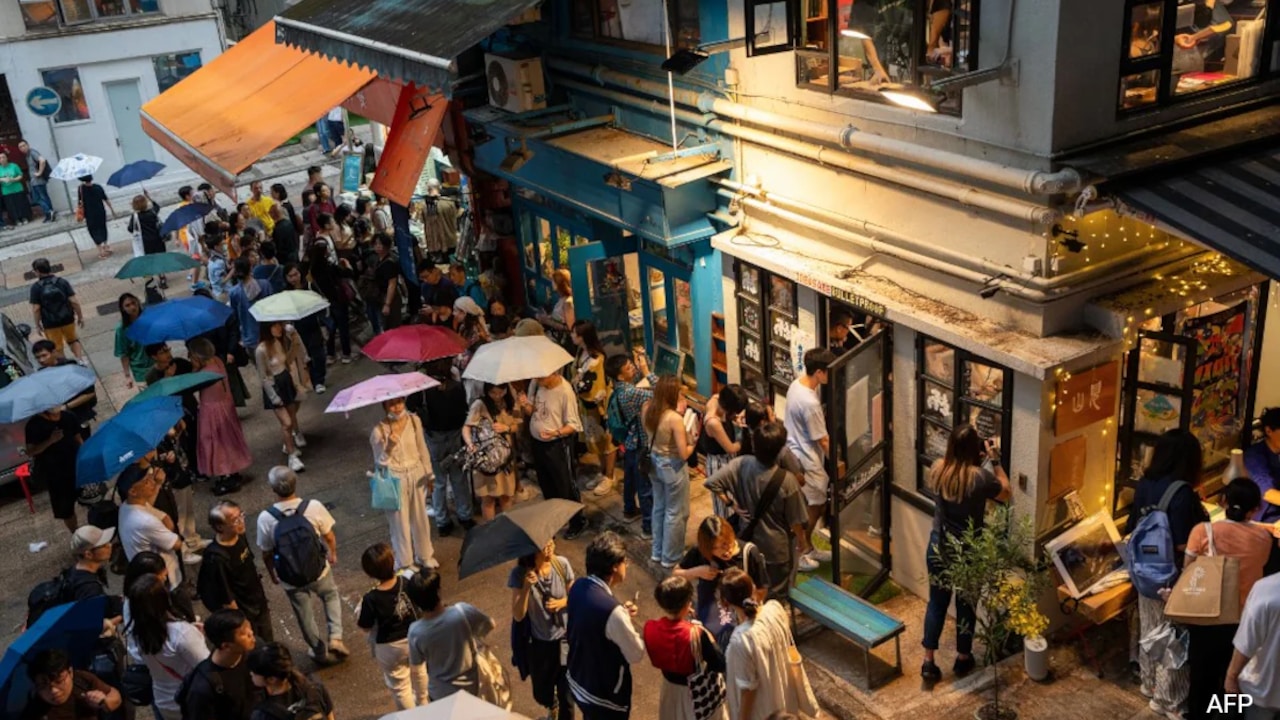
The independent bookshops of Hong Kong are vanishing, pushed out by a quiet panic that follows every sweep of the national security police. When Greenfield Book Store announced its impending closure after fifty years of operation, it marked more than the end of a commercial lease in Mong Kok. It signaled the final phase of an ideological transformation that has hollowed out one of Asia's most vibrant literary hubs. Recent raids resulting in the arrest of five individuals over alleged seditious publications have achieved what rising rents and digital competition could never accomplish. They have made the simple act of selling books an unmanageable hazard.
For decades, these independent storefronts functioned as intellectual sanctuaries. They carried niche philosophy, uncensored mainland histories, and radical political theory that official state channels ignored. Today, those shelves sit empty or have been replaced entirely by safe, government-approved titles. The mechanics of this collapse are not driven by sudden economic ruin alone, but by a chilling uncertainty known locally as the red line. When the boundaries of legality remain intentionally ambiguous, self-censorship becomes the only rational survival strategy for any small business owner.
The Anatomy of a Controlled Environment
To understand how a fifty-year-old institution like Greenfield folds under pressure, one must look closely at how the legislation operates on the ground. The security framework introduced following the 2019 protests criminalizes intent rather than explicit actions. Authorities do not need to prove a book caused immediate harm. They need only argue that a text possesses the capacity to provoke discontent against the administration.
Pro-government media outlets have frequently compared booksellers to food vendors. If a vendor sells poisoned food, the argument goes, they must be held accountable. This comparison reveals the core philosophy guiding the current administration. Reading unapproved histories or unsanctioned political critiques is treated as a form of intellectual poisoning. Consequently, independent operators are expected to act as ideological gatekeepers, screening every spine on their shelves for potential compliance violations.
Most small shops lack the legal counsel or the financial backing to risk a miscalculation. When Have A Nice Stay, a bookstore founded by former journalists, announced its immediate shutdown following police scrutiny, it highlighted the acute vulnerability of independent media figures. These individuals already lived under the microscope of state suspicion. Operating a bookstore without a corporate safety net meant that a single police visit would translate into immediate asset seizure and personal detention.
The Economic Realities Beneath the Surface
While the headline-grabbing raids provide the dramatic catalyst, financial pressures accelerate the final decisions. Commercial real estate in Hong Kong remains among the most expensive on earth. Independent bookshops operate on razor-thin margins, relying on loyal local communities and curious tourists to stay afloat. When foot traffic drops due to widespread social anxiety, revenue plummets.
Operating under a cloud of criminal liability changes the calculus of running a shop entirely. Suppliers grow hesitant to ship titles that might attract scrutiny at customs. Payment processors review merchant accounts with extreme caution, fearing secondary penalties under international trade rules or local security statutes. Customers, too, change their habits. Browsing public shelves for politically sensitive material now carries a psychological cost. People hesitate to linger in shops where plainclothes officers might walk through the door at any moment.
The financial strain is compounded by the mass migration of residents who once formed the core readership for independent literature. Tens of thousands of professionals, academics, and journalists have left the territory since 2020. They took their purchasing power and their hunger for open discourse with them. What remains is a shrinking market dominated by commercial chains that stick strictly to lifestyle magazines, children's literature, and mainstream fiction.
The International Blind Spot
Global attention flares up whenever high-profile arrests occur, but international response mechanisms have proven largely impotent. While foreign governments issue routine diplomatic condemnations, trade policies and geopolitical shifts often overshadow human rights concerns. Economic decoupling or normalization moves by Western capitals rarely account for the slow strangulation of civil society at the retail level.
Local authorities defend these measures by arguing that Hong Kong maintains its economic openness. Officials insist that business can continue as usual so long as operators respect national security. This argument relies on a false separation between economic freedom and intellectual freedom. History shows that commerce and culture do not exist in separate silos. When the freedom to read, write, and distribute independent thought is extinguished, the innovative energy that made the city a global financial powerhouse inevitably withers as well.
The Long Shadow on Regional Publishing
The crackdown extends far beyond the physical storefronts of Mong Kok and Causeway Bay. Printers, distributors, and independent publishers throughout the region are reassessing their operations. Warehouses containing back catalogs of politically sensitive titles have been quietly cleared out. Digital platforms hosted locally have scrubbed historical archives to avoid retroactive prosecution.
Authors who once used Hong Kong as a publishing base for works critical of authoritarian governance have shifted their operations to Taiwan, Europe, or North America. Yet, operating from a distance does not shield writers from intimidation. Cross-border enforcement mechanisms and digital surveillance create an extended perimeter of control. The ambition is clear: to ensure that no alternative narrative about modern history can be printed, sold, or read within striking distance of the mainland.
When the last independent bookstore closes its doors, the loss is irreversible. Shelves can be restocked, and storefronts can be leased to new tenants, but the institutional memory embedded in decades of community bookselling cannot be easily replaced. The disappearance of these spaces marks the end of an era when a reader could walk into a corner shop, strike up a conversation with an independent owner, and discover a world outside the official script.
The lights are turning off across the territory's literary landscape. What remains is a sanitized market where obedience masquerades as stability, and the freedom to think independently is treated as a relic of the past.