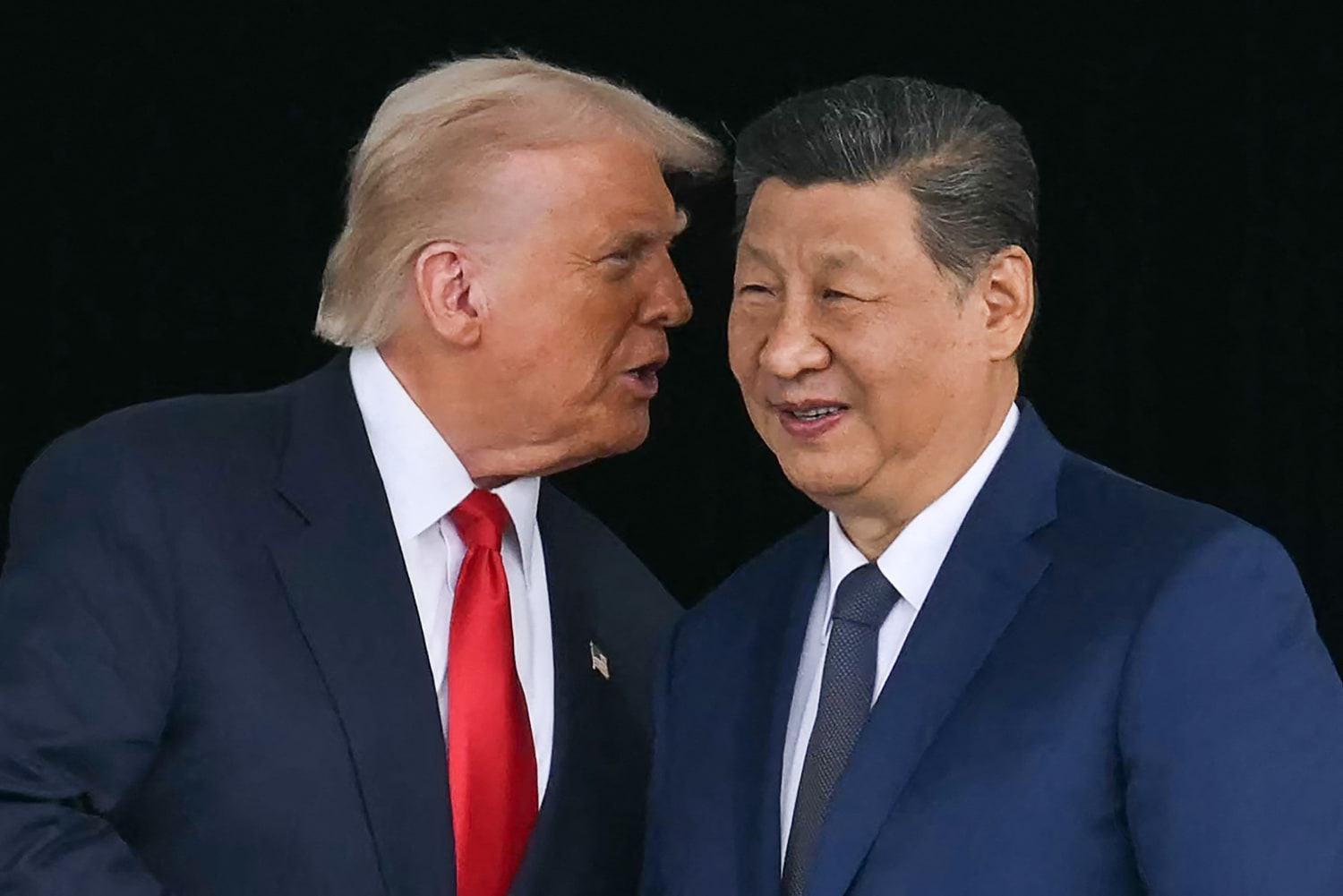
International relations under conditions of near-peer competition do not resolve through ideological consistency. They operate on a balance sheet of asymmetric vulnerabilities, transactional diplomacy, and institutional inertia. When heads of state pivot from casting an adversary as an existential menace to orchestrating high-protocol welcoming ceremonies, observers frequently diagnose moral contradiction. This diagnosis mistakes political rhetoric for operational strategy. The underlying dynamic governing contemporary superpower engagement is not rhetorical coherence, but mutual economic deterrence paired with the systemic necessity of managing transactional friction.
Evaluating this diplomatic pivot requires stripping away campaign rhetoric and examining the hard structural constraints facing both economies. The United States and China account for a dominant share of global gross domestic product, locking their financial systems, supply chains, and technological frontiers into a state of structural interdependence. Total systemic decoupling remains a theoretical talking point rather than an executable economic policy. Consequently, high-level diplomatic summits function as a mechanism for risk mitigation rather than alliance-building. Leaders deploy pageantry not to signal ideological alignment, but to establish a predictable floor beneath an otherwise volatile economic relationship.
The Asymmetry of Domestic Political Constraints
To understand why diplomatic posture shifts independently of geopolitical posturing, one must map the distinct domestic incentive structures governing executive action in Washington and Beijing.
The American political system imposes continuous electoral cycles, most notably midterms, which create acute sensitivity to short-term economic shocks. Broad-based tariffs, sudden supply chain fractures, or escalating trade skirmishes introduce inflationary pressures and corporate disruptions that register immediately at the ballot box. An administration facing these domestic vulnerabilities possesses minimal structural incentive to sustain an unmitigated escalation loop. Engaging in high-profile meetings allows executives to project strength while simultaneously securing temporary truces that stabilize markets and protect consumer-facing sectors.
Conversely, the leadership architecture in Beijing operates outside the immediate pressure of competitive electoral calendars, allowing for long-horizon strategic planning. However, the Chinese state faces its own structural imperatives, including maintaining high employment through industrial export models, managing real estate corrections, and navigating domestic economic transitions. For Beijing, high-level engagement with Washington serves two distinct functions: it validates its status as an equal global pole, and it prevents the consolidation of a unified Western economic containment bloc.
This divergence in domestic pressure points creates an asymmetric bargaining environment. One side seeks tactical stabilization to manage near-term macroeconomic variables, while the other leverages diplomatic normalization to secure long-term industrial positioning.
Mutual Economic Deterrence and Chokepoint Politics
The evolution of bilateral hostility over the past decade has fundamentally altered the mechanics of statecraft. Traditional economic sanctions and blanket tariffs have proven insufficient to dismantle entrenched industrial models. Instead, competition has migrated to specific structural chokepoints.
The United States retains formidable structural advantages centered on capital markets, financial plumbing, and foundational technology layers, particularly advanced computing and artificial intelligence development. These instruments allow Washington to restrict access to the technological frontier.
In response, Beijing has consolidated control over critical-mineral supply chains, rare earth element processing, and key manufacturing ecosystems. This dual-monopoly structure generates a condition analogous to Mutually Assured Destruction, but executed through commercial and technological vectors. Neither power can inflict catastrophic supply chain damage on the other without absorbing an equivalent economic shock.
[US Advantages: Capital Markets & AI Frontier]
              <--->
[Chinese Advantages: Critical Minerals & Manufacturing Chokepoints]
When mutual deterrence reaches parity, open-ended confrontation becomes economically irrational. The red carpet is not an indicator of trust; it is the physical manifestation of a stalemate. Both capitals recognize that systemic friction must be actively managed to prevent accidental escalation in theatres like the Taiwan Strait or the South China Sea.
The Transactional Bureaucracy of Superpower Management
Diplomatic summits structured around high symbolism and sparse concrete policy deliverables are frequently dismissed as superficial. This interpretation misreads their utility. When comprehensive grand bargains are structurally impossible due to fundamental disagreements over security architecture, human rights, and industrial policy, diplomacy shifts from resolution to containment.
Under this operational model, leaders utilize summit architecture to establish tactical guardrails across disparate policy dossiers. Trade compliance, technology restrictions, regional security concerns regarding Iran or North Korea, and transnational challenges such as precursor chemical controls are bundled into a single negotiation portfolio.
This linkage mechanism introduces both flexibility and volatility. It permits leaders to trade concessions across unrelated sectors—exchanging regulatory breathing room in one industry for enforcement cooperation in another. However, it also ties the stability of unrelated supply chains directly to the personal dynamics of executive-level meetings, removing predictability for multinational enterprises trying to forecast long-term capital allocation.
Strategic Forecast
The institutionalization of near-peer competition guarantees that systemic rivalry will persist beneath any veneer of diplomatic cordiality. The structural drivers of conflict—disputes over intellectual property, technological sovereignty, and territorial security—remain entirely unresolved by ceremonial pageantry or temporary tariff truces.
Multinational corporations and institutional investors must operate on the assumption that bilateral relations will liferate between tactical de-escalation and targeted economic statecraft. Supply chain redesigns, redundancy investments, and technological decoupling will continue irrespective of leader-level photo opportunities. Strategic stability in the current global order is defined not by the absence of rivalry, but by the sophistication of the mechanisms used to contain it. Capitalize on periods of diplomatic cooling to harden operational footprints against structural volatility, anticipating that future friction points will emerge swiftly around emerging technology standards and resource security.