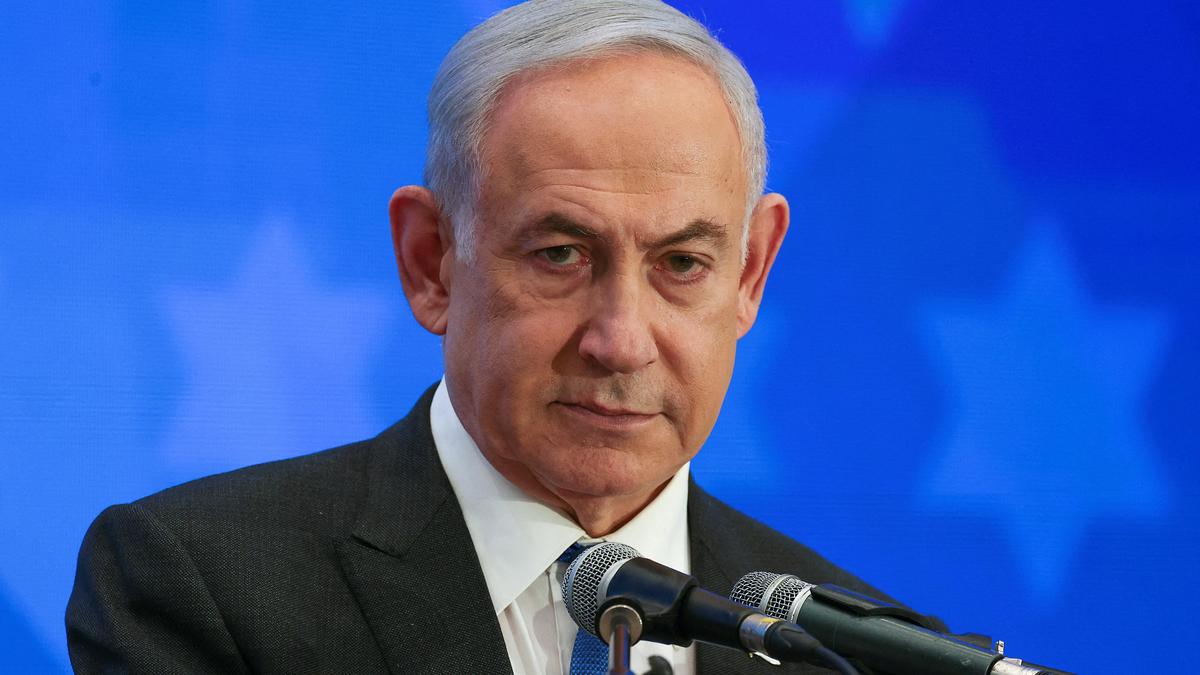
In a small, windowless apartment in Tel Aviv, a young man named Elias stares at a flickering screen until his eyes burn. He isn't looking for news in the traditional sense. He is looking for a seam. He scrolls through a video of Prime Minister Benjamin Netanyahu addressing the nation, his thumb hovering over the pause button. He is looking for a frame where the skin around the eyes doesn't crinkle quite right, or where the sync between the syllable and the jaw movement lags by a fraction of a millisecond.
Elias is caught in a modern fever dream. He is part of a growing collective of the hyper-skeptical who no longer believe their eyes. For him, the question is no longer about what the leader is saying, but whether the leader exists in that specific moment at all. For another look, see: this related article.
This is the psychological tax of the generative AI era. It isn't just about "fake news" anymore. We have moved past the era of the deceptive headline into the era of the deceptive existence. In the heat of the West Asia conflict, the truth hasn't just been buried—it has been liquefied.
The Architecture of Doubt
The war in West Asia is the first major global conflict to be fully mediated by accessible, high-fidelity synthetic media. In previous wars, propaganda was a matter of perspective. You saw the same tank, but one side called it a liberator and the other called it an occupier. Today, the tank itself might be a ghost. Related reporting regarding this has been provided by Engadget.
Consider the viral images that flooded social media in the wake of the October 7 attacks and the subsequent bombardment of Gaza. There were photos of charred remains and grieving families that were indistinguishable from reality. Then, the counter-narratives began. Fact-checkers pointed to hands with six fingers. They noted shadows that fell toward a sun that wasn't there.
But the damage is done the moment the image is rendered. Once a person sees a "deepfake" of a politician or a victim, their brain loses its anchor. Trust is a non-renewable resource. When it’s gone, we don't just stop believing the lies. We stop believing the truth.
This is the "Liar’s Dividend." It is a concept where actual, physical events can be dismissed as "just AI" by anyone they happen to inconvenience. If a video surfaces of a soldier committing a crime, or a leader making a confession, the defense is now built-in. "It’s a deepfake," they say. And because we know the technology exists, we can't prove them wrong without a week-long forensic investigation. By then, the news cycle has moved on. The ghost has won.
The Anatomy of the Synthetic War
To understand how deep this goes, we have to look at the tools. We aren't talking about Hollywood-level CGI that costs millions. We are talking about open-source models that run on a standard gaming laptop.
Generative Adversarial Networks (GANs) work like a high-stakes game of art forgery. One part of the AI, the "generator," tries to create an image. The other part, the "discriminator," tries to spot the flaw. They loop billions of times. The generator fails, learns, and tries again. It continues until the discriminator—and by extension, the human eye—can no longer tell the difference.
In the context of the Israel-Hamas war, this technology has been used to manufacture outrage on a scale previously unimaginable. We saw AI-generated images of "tent cities" that looked more like cinematic concept art than reality. We saw audio clips of leaders supposedly plotting escalations. These aren't just pranks. They are weapons of cognitive dissonance.
When Netanyahu’s videos are analyzed for "realness," the irony is that his physical presence is almost irrelevant. The digital version of him—the one that lives on X, Telegram, and TikTok—is the one that moves markets and starts riots. Whether the pixels originated from a camera lens or a server farm in a basement, the blood spilled in response is real.
The Human Cost of the Uncanny Valley
Think about Sarah. She lives thousands of miles away from the front lines, but she consumes the war through her phone for six hours a day. She sees a video of a child pulled from rubble. She feels a surge of genuine, human empathy. Then, she scrolls down to the comments.
"AI-generated. Look at the lighting on the hair," one user writes.
"Pallywood," says another. "Fake."
Sarah looks back at the child. Is the grief she felt a mistake? She feels foolish. She feels manipulated. The next time she sees a real photo of a real child in real pain, she hesitates. That hesitation is the death of empathy. That is the invisible stake of this war. When we can no longer trust our biological response to suffering, we become harder. More cynical. Less human.
The "Uncanny Valley" is a term used to describe the revulsion we feel when something looks almost human, but not quite. In West Asia, the entire information ecosystem has fallen into that valley. Everything feels slightly off. The speeches feel scripted by algorithms—and in some cases, they might be. The battle footage feels like a video game. The rhetoric feels like it was optimized for engagement by a machine that thrives on conflict.
The Mirage of Neutrality
We often think of AI as a neutral tool, a mirror of our own data. But AI is trained on us. It is trained on our biases, our anger, and our tendency to click on the most sensational version of a story.
When an AI is asked to "generate a photo of the war in Gaza," it doesn't look at the world. It looks at every photo ever taken of the region. It sees the rubble, the dust, the specific shade of olive drab in the uniforms. It distills the war into an aesthetic. It turns tragedy into a prompt.
The problem with a "Netanyahu or AI" debate isn't that we might be fooled by a fake. It's that the real Netanyahu has to compete with an AI-optimized version of himself. The real world is messy. Real leaders stumble over words. They have bad lighting. They look tired. AI doesn't get tired. AI can be programmed to be more "Netanyahu" than the man himself—more defiant, more eloquent, more terrifying.
The Forensic Hunt for the Truth
There are people fighting back. Digital forensic experts spend their nights looking at the metadata of files, searching for the "digital fingerprint" left by AI. They look for "noise patterns"—microscopic inconsistencies in the pixels that occur when a machine tries to simulate the random chaos of a camera sensor.
But this is an arms race where the defense is always two steps behind. By the time a video is debunked, it has already been viewed twenty million times. It has already been cited in protests. It has already hardened the hearts of those who wanted it to be true.
We are living through a period of "epistemic fragmentation." We aren't just disagreeing on the facts; we are disagreeing on the nature of reality itself. In this environment, the most powerful person isn't the one with the best army, but the one with the best algorithm.
The Weight of the Click
The digital fog of war is not a weather pattern. It is an intentional environment. It is designed to make you give up. When the world becomes too confusing to parse, the natural human reaction is to retreat into a tribe. We stop looking for what is "true" and start looking for what "belongs" to our side.
If a video supports my worldview, I share it. If it challenges my worldview, I call it AI.
This behavior creates a feedback loop that the AI models love. The more we engage with polarized content, the more the algorithms feed us. The more we are fed, the more we produce. The loop tightens until there is no room for the nuance of the human experience. There is only the prompt and the output.
Elias, back in his Tel Aviv apartment, finally puts his phone down. He hasn't found a seam. He hasn't found proof of a deepfake. But he hasn't found peace, either. He goes to the window and looks out at the city. He sees the cars, the streetlights, the people walking their dogs. For a second, he wonders if the lighting on the trees looks too perfect.
He shakes his head, trying to clear the digital soot from his brain. But the doubt remains. It sits in the back of his throat like a cold stone.
The greatest tragedy of the AI-inflected war in West Asia isn't that we will be lied to. It’s that even when the truth is staring us in the face, shouting, bleeding, and weeping, we will have forgotten how to recognize it. We are looking for the ghost in the machine, unaware that the machine has already turned us into ghosts of ourselves.
The screen stays dark, but the war continues, rendered in the high-definition silence of a world that has lost its pulse.